The War on Drugs
Explore the history of the war on drugs


The War on Drugs Was Never Just About Drugs
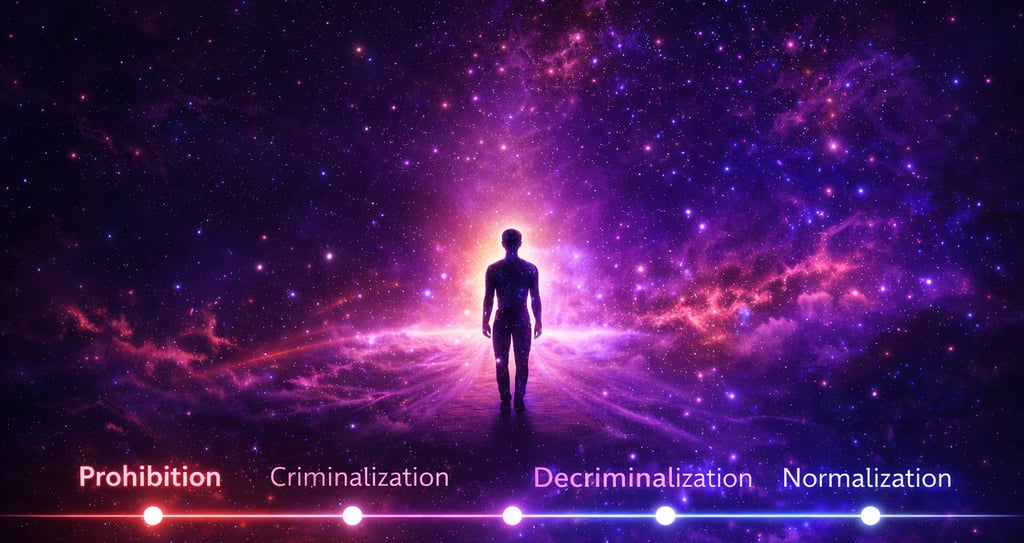
For over 50 years, governments—especially in the United States—have waged what they called a “War on Drugs.”
It wasn’t framed as a war against people.
It was framed as a war against substances.
But the effects reached far beyond substances.
They reached into consciousness itself.
This raises a deeper question:
Was the war really about drugs—or about controlling which states of mind were considered acceptable?
The Official Reason: Public Safety
Officially, the War on Drugs began in 1971 when President Nixon declared drug abuse “public enemy number one.”
The stated goals were simple:
Reduce addiction
Reduce crime
Protect public health
Maintain social order
From a surface level, these goals make sense. Governments are expected to maintain stability.
But over time, contradictions began to emerge.
Alcohol—one of the most harmful substances physiologically—remained legal.
Meanwhile, other substances with different effects—some associated with introspection, altered perception, or emotional shifts—were aggressively criminalized.
This inconsistency made people start asking deeper questions.
Productivity, Predictability, and Control
Modern society runs on predictability.
People wake up at scheduled times.
Work fixed hours.
Perform repeatable tasks.
Systems rely on consistency.
Anything that disrupts this predictability—whether it’s exhaustion, burnout, or altered perception—becomes a threat to the machine.
Not because it’s inherently dangerous.
But because it introduces unpredictability.
Governments and institutions historically prioritize:
productivity
stability
predictability
States of mind that reduce compliance with routine structures naturally fall outside those priorities.
The Cultural Fear of Altered Consciousness
During the 1960s and 1970s, altered states became closely associated with counterculture movements.
These movements questioned:
authority
war
consumerism
traditional life paths
Whether fairly or unfairly, altered consciousness became symbolically linked with social disruption.
As a result, substances associated with those states became politically charged.
This wasn’t just about chemistry.
It was about culture.
The Economic Layer No One Talks About
Governments don’t operate in isolation.
They operate alongside massive industries, including:
pharmaceuticals
alcohol
tobacco
healthcare systems
These industries are structured, regulated, and taxed.
Unregulated alternatives exist outside those systems.
Anything outside established economic channels creates uncertainty.
Not necessarily danger—but uncertainty.
Governments historically move to regulate uncertainty.
The Real Question: Who Decides Your Default State?
Every society has a “default acceptable state.”
Alert. Focused. Productive. Predictable.
This state makes systems run smoothly.
But human experience isn’t limited to one mode.
Humans naturally cycle through many states:
calm
inspired
introspective
creative
detached
energized
These states are part of being human.
The tension arises when systems prioritize only one of them.
The Shift Happening Right Now
Over the last decade, public attitudes have shifted dramatically.
Things once considered unthinkable are now openly discussed.
Research into consciousness, mental health, and perception is expanding.
People are asking new questions:
Not just “What is allowed?”
But “Why was it forbidden in the first place?”
This shift isn’t driven by rebellion.
It’s driven by curiosity.
The Future Will Be Defined by Awareness
The War on Drugs shaped generations.
But it also sparked something else.
Questions.
Questions about authority.
Questions about freedom.
Questions about who decides what’s acceptable.
Ultimately, the future won’t be defined by substances.
It will be defined by awareness.
Awareness of systems.
Awareness of choices.
Awareness of self.
Because the most powerful shift isn’t chemical.
It’s conscious.
Flocozy exists to help people explore comfort, calmly and consciously.
Not to escape reality.
But to understand it differently.
FlōCozy
Explore our sleek website template for seamless navigation.
Contact
Newsletter
support@flocozy.com
262-705-4575
© 2026. All rights reserved.